
Tarco Mzansi adapts materials and methods for parking areas and estates
Rising surface temperatures on Gauteng roads are exposing the practical limits of conventional asphalt crack sealers, especially in parking areas and residential estates. Tarco Mzansi has seen repeated cases where sealers soften, stay tacky, and pump out of cracks under turning and lateral traffic loads.
The company previously used CE-1, a polymer-modified crack sealer. The TG1 manual lists its softening point at 80°C. In practice, heating the material above roughly 60°C causes the polymers to degrade. After application, the effective softening point can drop to 60°C or lower. When large batches are reheated the next day, it can fall further to 50–55°C.
This leaves the sealer vulnerable in Gauteng’s climate. Air temperatures regularly exceed 40°C on hot days, while road surfaces routinely reach 50–60°C. On heatwave days, particularly on freshly rejuvenated pitch-black surfaces, infrared readings have recorded surface temperatures of 65–70°C.
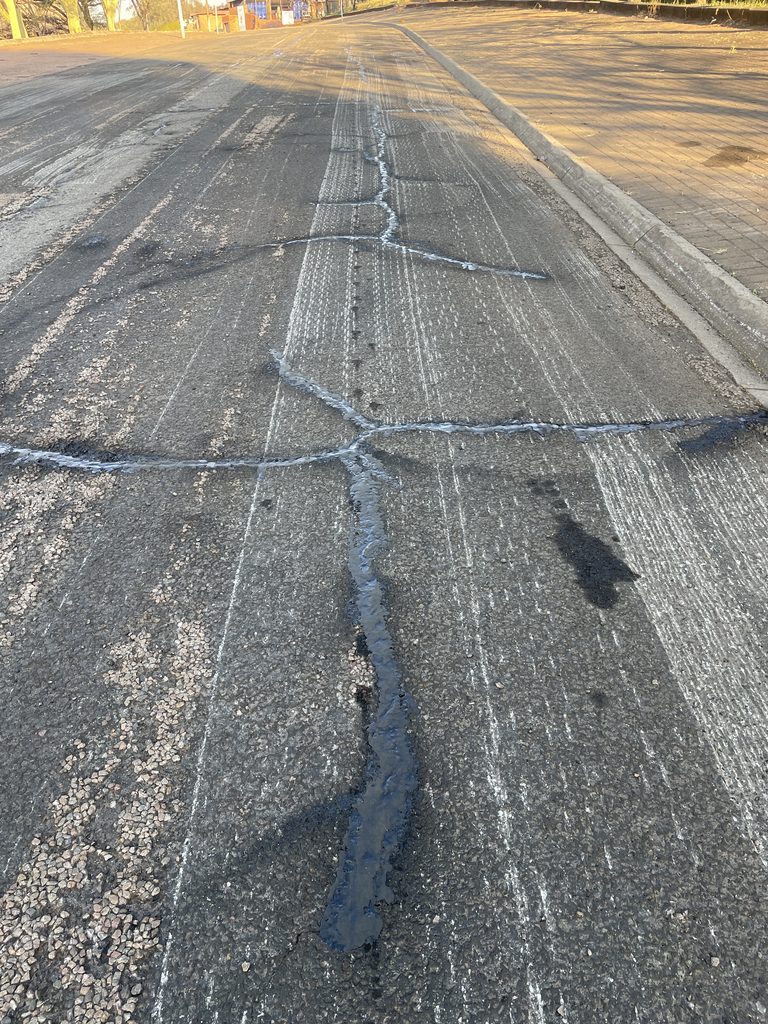
Tarco Mzansi later moved to CR-1, a rubber-based product with a TG1 softening point of about 65°C. Because it contains far less polymer that breaks down under heat, its softening point stays relatively stable between 60°C and 65°C even after reheating. While this is an improvement, it is still not enough when pavement temperatures climb into the mid-to-high 60s or low 70s.
The problem is most severe in areas with significant wheel-turning and lateral movement, such as parking lots at malls and strip malls, and internal roads in estates. On long, straight routes with mainly through traffic, the sealer experiences less mechanical stress and tends to remain in place. In parking areas and estates, temperatures above the softening point combined with turning forces keep the material tacky and force it upward out of the cracks. The result is sticky surfaces that can track onto vehicles and speed up further deterioration.
As an interim fix, Tarco Mzansi has been applying bitumen-coated crusher sand over the fresh crack sealer immediately after placement. The sand creates a thin layer of voids between the driving surface and the sealer, reducing direct tyre contact and limiting pumping. Field results have been positive, with better stability and less tracking in treated areas.

The company is also developing a new crack sealer formulation aimed at a higher post-application softening point of around 75°C after heating and placement. Laboratory work is under way to achieve this while keeping the product workable and adhesive. The target is a sealer suited to the demanding conditions in parking areas, estates, and other high-stress, high-temperature environments in Gauteng and similarly hot regions such as KwaZulu-Natal. Once refined, it is expected to be used on Tarco Mzansi’s own projects and made available to other contractors across South Africa.
Tarco Mzansi continues to treat crack sealing as an evolving practice rather than a fixed method. By measuring actual road temperatures, monitoring how products behave after heating, and adjusting both materials and application techniques, the company aims to reduce client disruptions and deliver repairs that better withstand the province’s increasingly severe heat.